S'extérioriser en soi-même
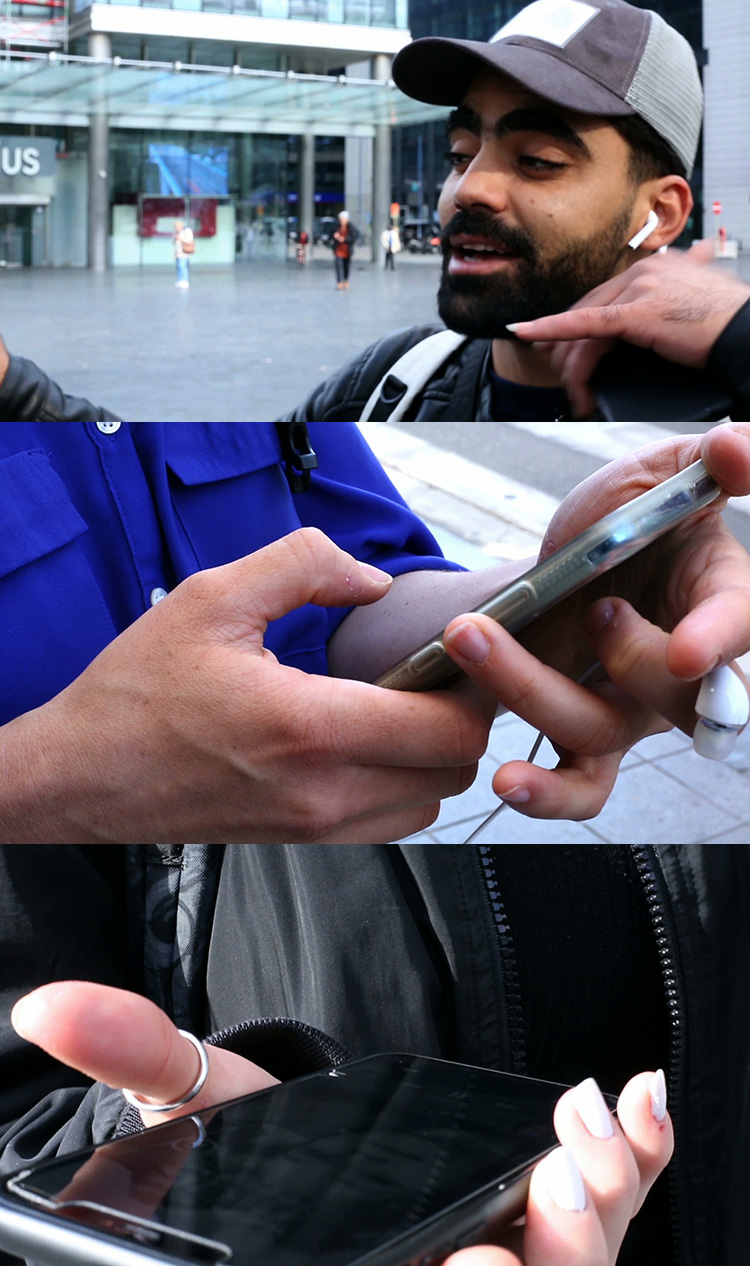
How does one perception superimpose itself onto another? How does an imaginary interfere with the reality of a place?
The practice of listening to music on headphones in urban space offers a field of inquiry for addressing this double question. Chosen listening imprints other rhythms and other narratives onto the daily experience of the city, its movements and its latencies. Lyrics and sounds are superimposed onto the existing sound environment, necessarily altering perception. The question is whether this is a simple collage or a deeper intertwining.
From its appearance in the 1980s, the first mainstream portable technology, the Walkman, was associated with a risk of dereliction — a criticism directed at 'youth,' who were thereby accused of displaying an attitude of withdrawal from the community. For their part, users experienced a dimension invisible to conservatives. A young man, asked by a journalist about his use of chosen listening, could reply with a paradoxical formula: it allowed him to 'externalize himself inwardly.'
Behind this oxymoron emerges a new perception of the city, unsettling for identities — those of individuals and those of places.
Comment une perception se superpose-t-elle à une autre ? Comment un imaginaire interfère-t-il avec la réalité d’un lieu ?
La pratique consistant à écouter de la musique au casque dans l’espace urbain offre un terrain d’enquête pour aborder cette double question. L’écoute choisie imprime à l’expérience quotidienne de la ville, à ses mouvements et à ses latences, d’autres rythmes et d’autres récits. Des paroles et des sonorités se superposent à l’environnement sonore existant, en modifiant nécessairement la perception. La question est de savoir s‘il s’agit d’un simple collage ou d’une intrication plus profonde.
Dés son apparition dans les années 1980, la première technologie portative grand public, le Walkman, a été associée à un risque de déréliction, une critique dirigée contre la « jeunesse » accusée par là d’afficher une attitude de retrait vis-à-vis de la communauté. De leur côté, les utilisatrices expérimentaient une dimension invisible aux yeux des conservateurs. Un jeune homme interrogé par un journaliste sur son usage de l’écoute choisie pouvait répondre, d’une formule paradoxale, que cela lui permettait de « s’extérioriser en lui même ».
Derrière l’oxymore se dessine une perception neuve de la ville, déstabilisante pour les identités, celles des individus et celles des lieux.
Conversion
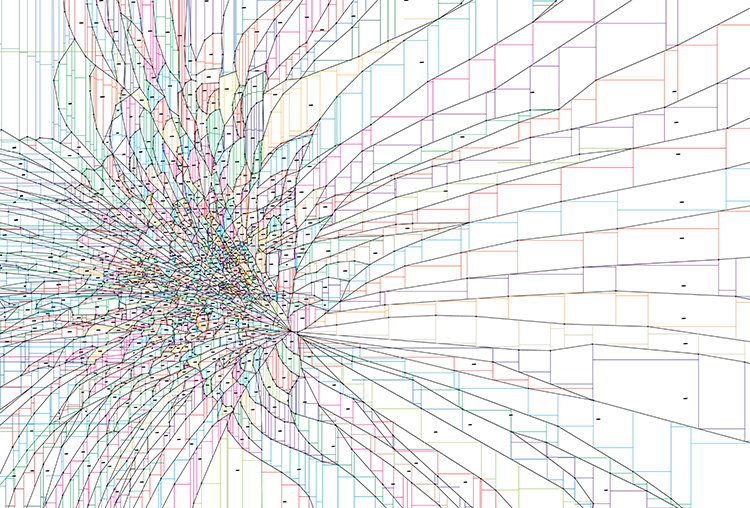
Since the 1970s, laminated glass has been present in urban spaces, where it has made it possible to observe broken windowpanes that do not collapse but instead appear as so many "maps". By following the edges of their fractures, by measuring the spacing between their points, one obtains numerical geometric data that can be converted into sonic properties.
This conversion is faithful to the physics of sound, according to which an object with a larger surface area resonates at a lower frequency and for a longer duration. The planar surface is read by longitudinal scanning, a movement analogous to that of a pedestrian walking along an avenue. With a constant amplitude, the sonic phenomenon results from the continuous variation of frequency combinations.
Starting from the visual experience of broken windowpanes, the work proposes a shift by analogy toward the sonic realm. Broken windowpanes, no longer catching the eye, become sirens, test signals, reflected back by the walls of the exhibition space.
Depuis les années 70 le verre feuilleté est présent dans l’espace urbain où il a rendu possible l’observation de vitres brisées qui ne s’effondrent pas mais s’affichent comme autant de plans. En suivant les arêtes de leurs bris, en mesurant l’écartement de leurs points, on obtient des données géométriques chiffrées convertibles en propriétés sonores.
Cette conversion est fidèle à la physique des sons qui veut qu’un objet d’une plus grande surface résonne d’une plus basse fréquence sur une plus longue durée. Le plan est lu par balayage longitudinal, déplacement analogue à celui d’un piéton le long d’une avenue. D’une amplitude constante, le phénomène sonore résulte de la variation continue des combinaisons de fréquences.
Depuis l’expérience visuelle des vitres brisées, l’œuvre propose un glissement par analogie vers le domaine du sonore. Des vitres brisées, n’accrochant plus le regard, deviennent des sirènes, des bandes tests, que renvoient les murs de l’espace d’exposition.
Construire reconstruire
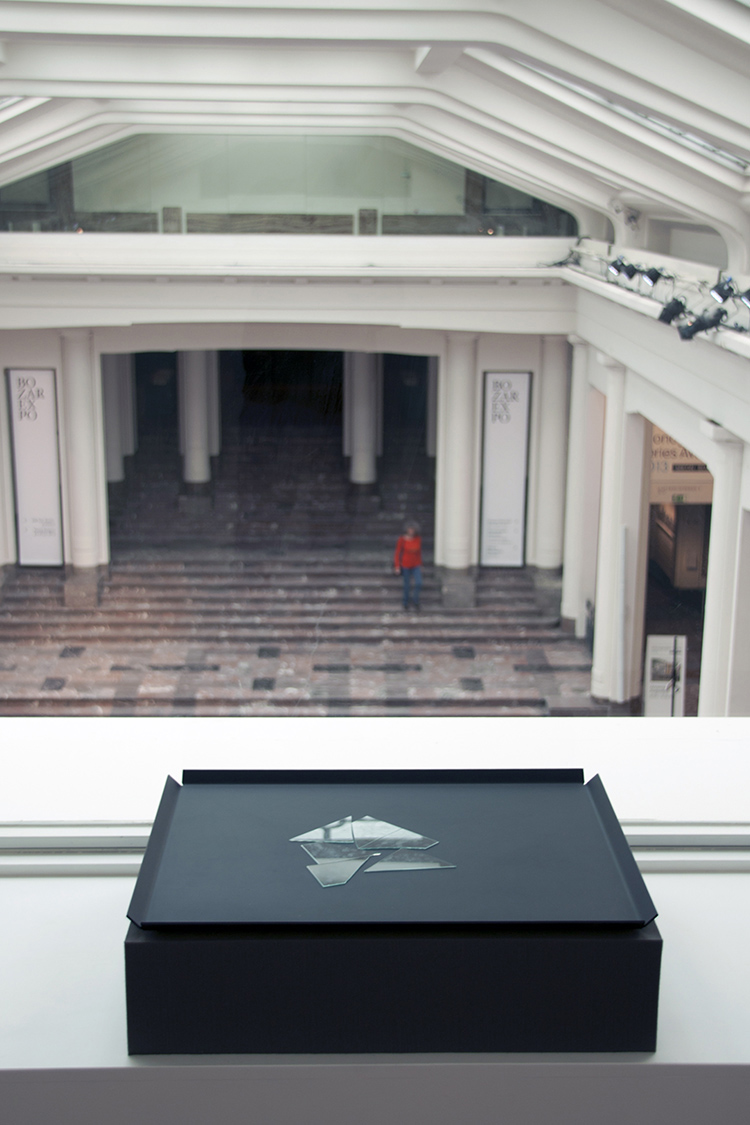
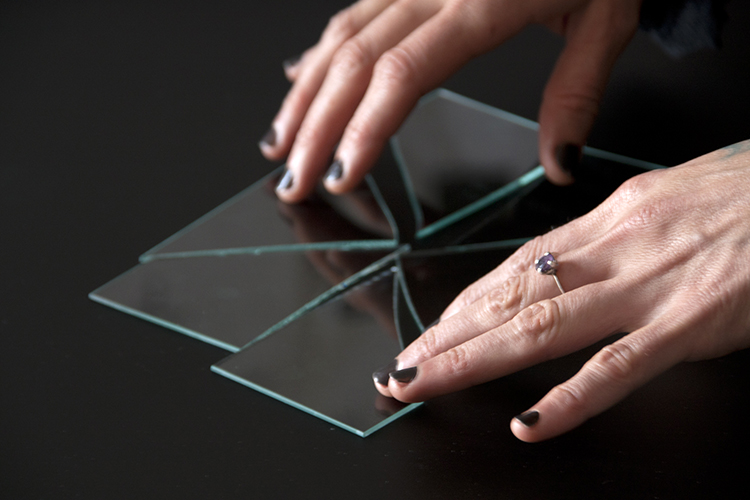
Three metal trays hold varying numbers (2, 4, 6) of pieces resulting from the division of a standard 10x15cm glass plate. Each tray rests on a block of synthetic foam and vibrates imperceptibly at a set frequency.
The glass fragments can be manipulated and reassembled into their complete shape. Each tray then reveals a slow dislocation, either because the pieces move apart or because they converge toward a single point of attraction that they cannot all occupy at the same time.
Trois plateaux métalliques accueillent en nombres variables (2,4,6), les parties résultant de la division d’une plaque de verre de format standard: 10x15cm. Chaque plateau repose sur un bloc de mousse synthétique et vibre imperceptiblement selon une fréquence déterminée.
On peut manipuler les fragments de verre et reconstituer leur format d'origine. On perçoit alors une lente dislocation, soit parce que les parties s’éloignent, soit parce qu’elles se dirigent vers un même point d’attraction qu’elles ne peuvent occuper toutes en même temps.
Fenêtre de réflexion
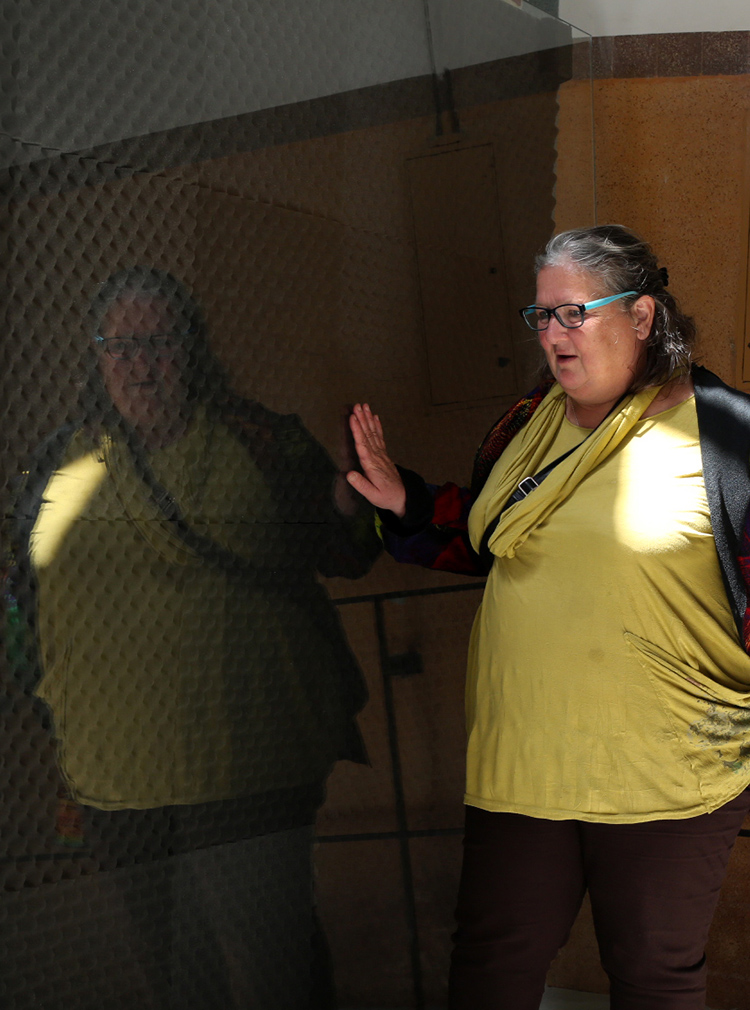
The installation consists of a glass panel, whose dimensions could be those of a shop window. It rests against a structure that conceals the entrance to the space and vibrates at a low frequency (22 Hertz). The vibrations, nearly inaudible, are particularly visible on the edges, where they produce a wave-like phenomenon, and, in a different way, across the entire surface of the glass, which reflects a blurred image of bodies and the architecture.
L’installation se compose d’une plaque de verre, dont les dimensions pourraient être celles d’une devanture de magasin. Elle repose contre une structure qui occulte l’entrée de l’espace et vibre à basse fréquence (22 Hertz). Les vibrations, quasi inaudibles, sont particulièrement visibles sur les tranches où elles produisent un phénomène ondulatoire et, d’une autre manière, sur toute la surface de la vitre qui renvoie une image brouillée des corps et de l’architecture.
Réflexion faite
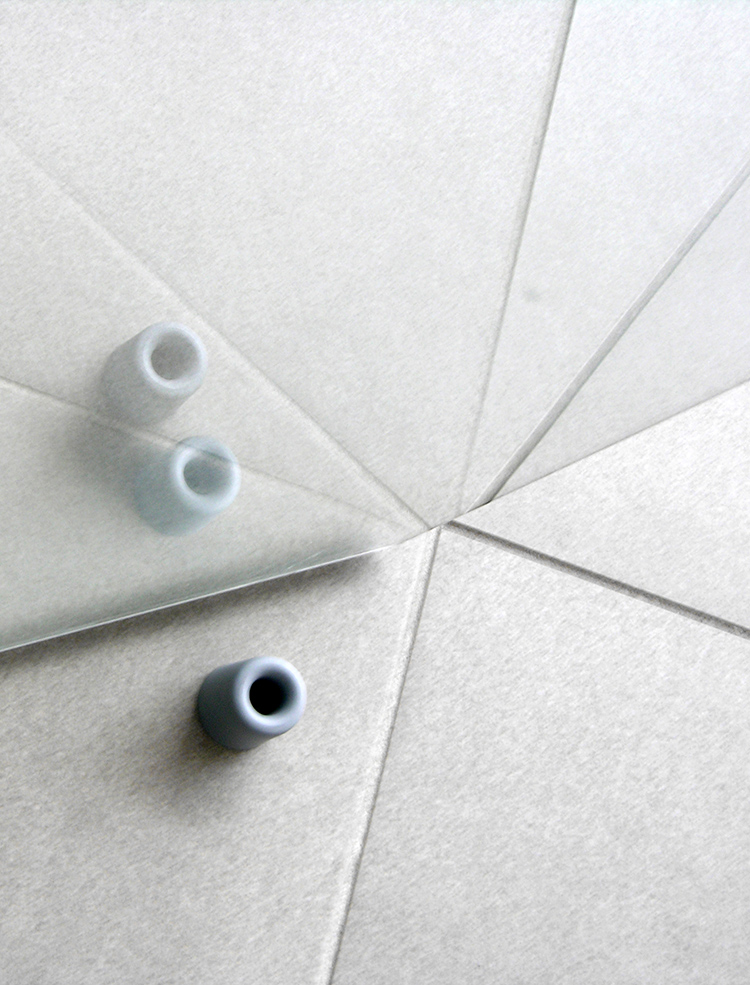
Two rubber stops are placed on either side of a glass door. Their spacing has been carefully determined to create the illusory appearance of a third stop. When the door is moved, the ghost image passes through the obstacles of which it is the reflection and can be observed outside the space they enclose.
Deux butées en caoutchouc sont disposées de part et d’autre d’une porte vitrée. Leur écartement a été soigneusement déterminé pour produire l’apparition illusoire d’une troisième butée.
Lorsque la porte est manipulée, l’image fantôme traverse les obstacles dont elle est le reflet et peut être observée hors de l’espace que ceux-ci délimitent.
Étendre le film
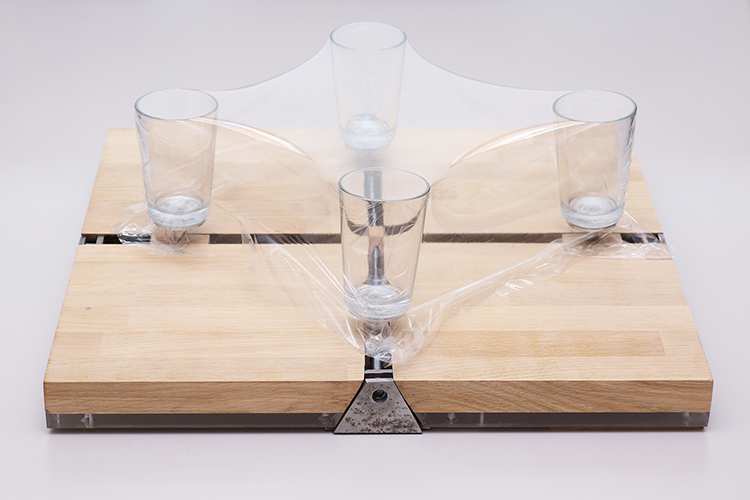
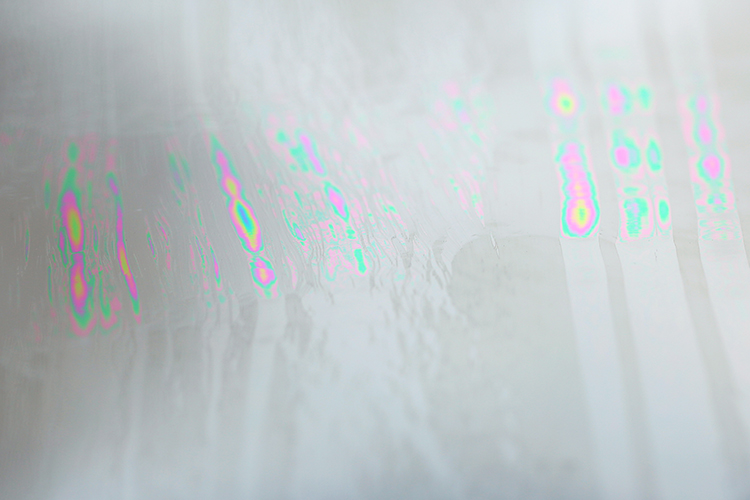
A transparent plastic film, of the type used for handling, storing, and transporting goods, when abnormally stretched, shows signs on its surface of separation among its constituent materials: polyethylene, plasticizers, elastomers... Stretched to the breaking point, when its thickness approaches the order of a micron, it becomes what physicists call a thin film: a fine layer that interferes with light, reflecting certain waves while allowing others to pass through invisibly.
Un film plastique transparent, de ceux employés pour la manutention, le stockage et le transport des marchandises, anormalement étiré montre à sa surface des signes de séparation des matières qui le composent : polyéthylène, plastifiants, élastomères... Étiré à la limite de la rupture, quand son épaisseur avoisine l’ordre du micron, il devient ce que les physiciens nomment une lame mince : une fine pellicule interférant avec la lumière, renvoyant certaines ondes tandis que d’autres la traversent invisiblement.
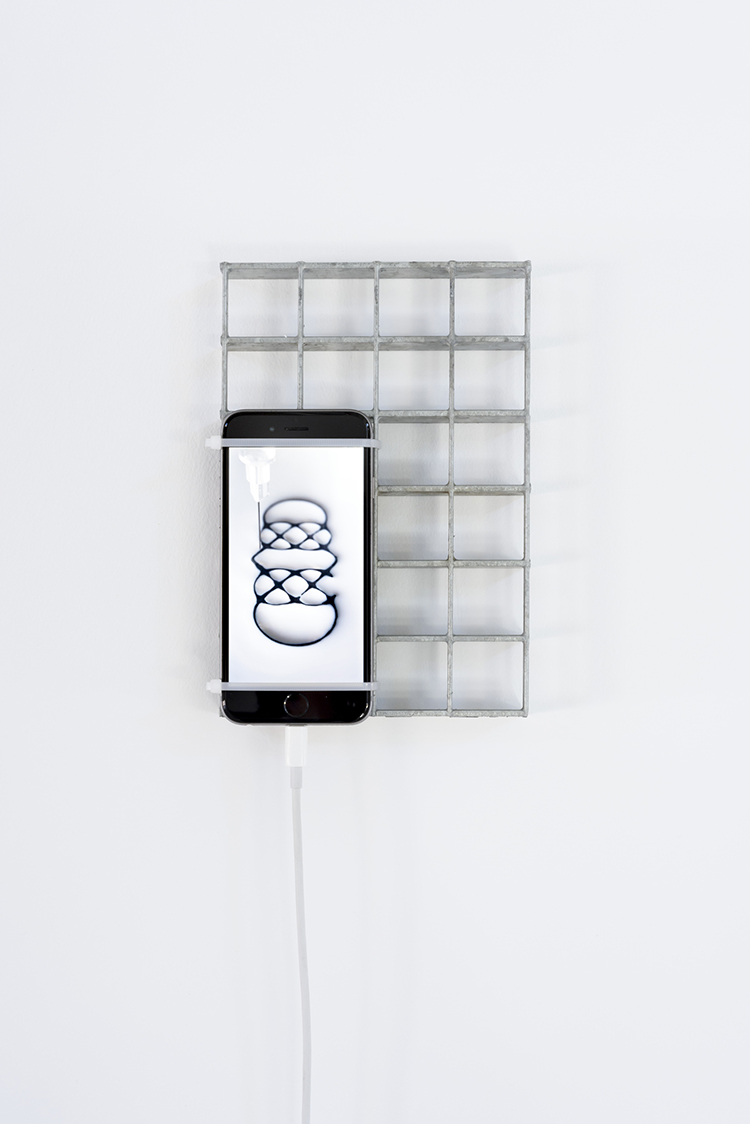
Le parcours qu'il faut effectuer pour parvenir au Pays des Morts (série)
Graphs represent movements, and from this they derive a power of evocation. They can evoke the configuration of a place, a technical arrangement, power relations, the articulation of the elements of a narrative... Depending on the cultural context, they can thus evoke different things, much like a writing system can have different meanings in different languages.
Here, graphs are inscribed by a continuous mechanical airflow into a liquid. The installation presents them in relation to an everyday technology — a portable screen — and an element of collective architecture — a galvanized steel grating ordinarily placed on the floor.
Les graphes représentent des déplacements, de là ils reçoivent un pouvoir d’évocation. Ils peuvent évoquer la configuration d’un lieu, un agencement technique, des rapports de pouvoir, l’articulation des termes d’un récit... Selon les contextes culturels ils peuvent donc évoquer des choses différentes à la manière d’une graphie ayant des significations différentes dans des langues différentes.
Ici des graphes sont inscrits par un souffle dans un liquide. L’installation les présente en relation avec une technologie quotidienne, un écran portable, et un élément de l’architecture collective, une grille en acier galvaniser ordinairement placée au sol.
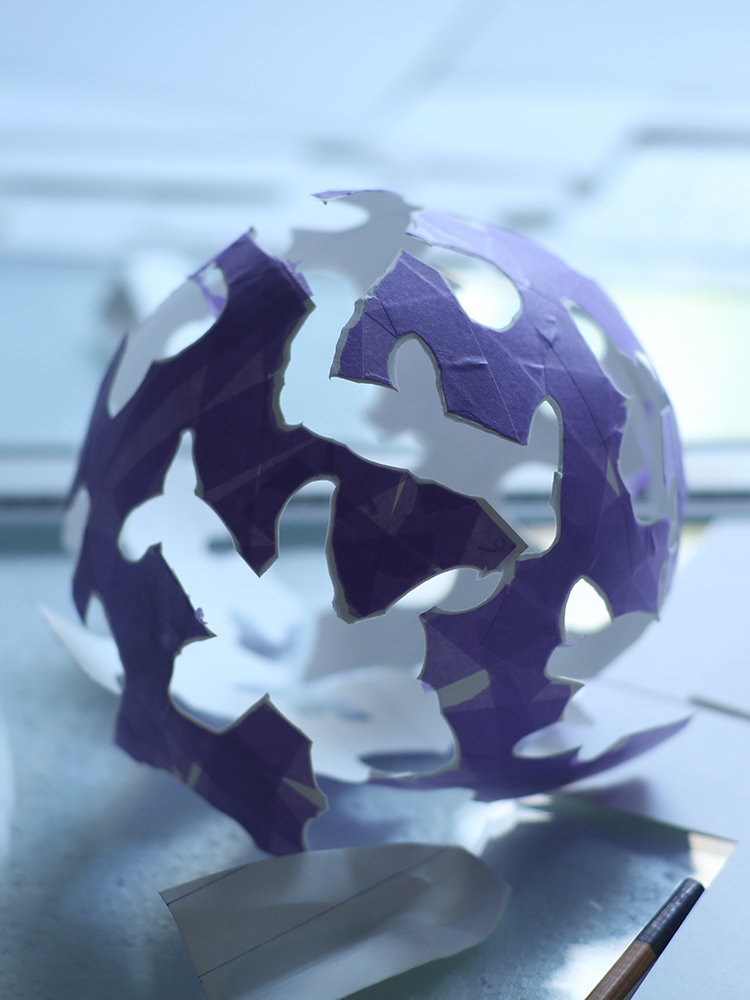
Le rêve d'un cerveau violet
There are eleven different nets that can be folded into a cube, and none that can form a complete sphere from a flat surface. It is impossible to make the surface of a cube coincide with that of a sphere as if cubes and spheres, except for a few points, do not occupy the same space. Yet one can imagine a cube inflating until it becomes a sphere, or a sphere rolling over the faces of a cube until it becomes entirely covered by them, or even a sphere from inside a cube sucking it in and crushing it onto its own surface. One can also cut out a cube net from paper and gradually apply it to a sphere using adhesive, then trim away the excess relief with a blade. What remains is the surface common to both shapes, or rather a "path" leading from one shape to the other.
Il existe onze patrons différents permettant de construire un cube et aucun permettant de former une sphère complète à partir d’une surface plane. Il est impossible de faire coïncider la surface d’un cube et la surface d’une sphère ; comme si les cubes et les sphères, à l’exception de quelques points, n’occupaient pas le même espace. Cependant on peut imaginer un cube qui gonfle jusqu’à devenir une sphère, ou une sphère roulant sur les faces d’un cube jusqu’à en être entièrement recouverte, ou encore une sphère qui de l’intérieur d’un cube l’aspire et l’écrase à sa surface. On peut aussi découper dans du papier le patron d’un cube et l’appliquer progressivement à l’aide d’adhésif sur une sphère et avec une lame retirer les reliefs en excès. Il restera la surface commune aux deux formes ou plutôt un « chemin » menant d’une forme à l’autre.
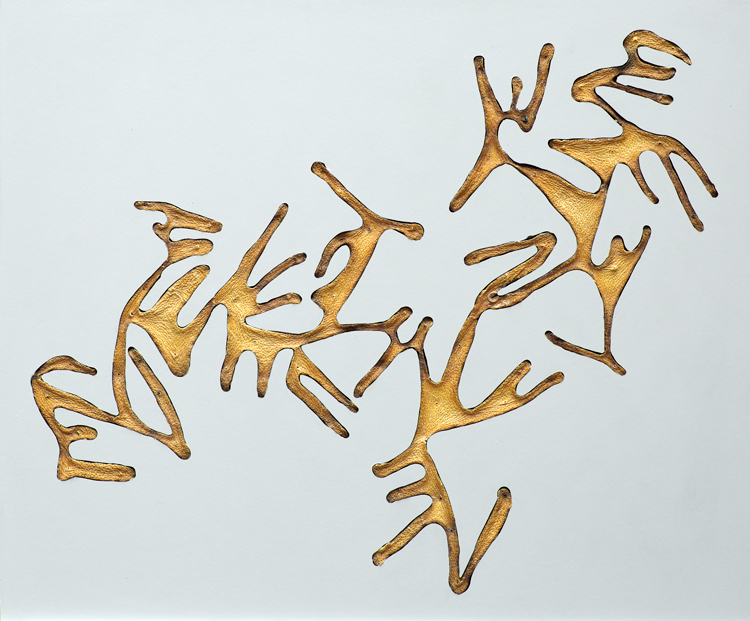
Détour dans le monde de l'à peu près (série)
The surface of a sphere is unique in that it has no edges. Cutting it out and laying it flat is tantamount to inventing edges for it. While in geometry it is not possible to ‘flatten’ a sphere, in practice you can cut the surface of a grapefruit or an orange in one piece and lay it out on a flat surface. It is possible, provided that the path that will give the cut-out its outline has travelled through all the regions of the sphere without ever intersecting or returning to its starting point.
La surface d’une sphère a la particularité d’être sans bords. La découper et la mettre à plat équivaut à lui inventer des bords. Tandis qu’en géométrie « mettre à plat » une sphère n’est pas possible ; en pratique on peut découper d’un seul tenant la surface d’un pamplemousse ou d’une orange et l’étendre sur une surface plane. On peut, à condition que le chemin qui donnera son contour à la figure découpée ait parcouru toutes les régions de la sphère sans jamais se recouper ou revenir à son point de départ.
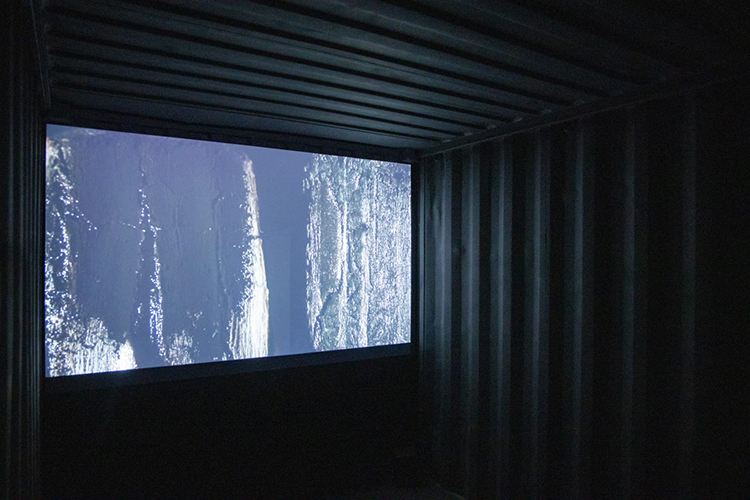
 Robert Hooke, one of the first makers and users of microscopes, published a collection of drawings in 1665 under the title Micrographia. One of these drawings depicted the microscopic structure of a thin slice of wood. The descriptive approach he adopted, based on curiosity and observation, was not concerned with a possible rupture between Seeing and Knowing. In Interno, we find this same attitude of moving closer, more than usual, to an ordinary object in order to give it sharp attention. Pieces of wood burn. From this combustion emerge sonic phenomena (rhythms, cracklings) captured by acoustic probes placed inside the wood, and surface phenomena (flows, glimmers) recorded by the camera. As a result, the domain of the Sonic coincides only rarely with that of the Visible.
Robert Hooke, l’un des premiers fabricants et utilisateurs de microscopes, publia, en 1665, une collection de dessins sous le titre Micrographia. Un de ces dessins représentait la structure microscopique d’une fine tranche de bois. La démarche descriptive qu’il
empruntait, fondée sur la curiosité et l’observation, ne s’inquiétait pas d’une rupture possible entre Voir et Savoir. Dans Interno, on retrouve cette attitude consistant à se rapprocher, plus que d’ordinaire, d’un objet banal afin de lui accorder une attention aigüe.
Des morceaux de bois se consument. De cette combustion, émergent des
phénomènes sonores (des rythmes, des craquements) captés par des sondes
acoustiques placées à l’intérieur du bois et des phénomènes de surface (des coulées, des
scintillements) enregistrés par la caméra. De sorte que le domaine du Sonore ne
coïncide qu’à de rares occasions avec le domaine du Visible.
Robert Hooke, one of the first makers and users of microscopes, published a collection of drawings in 1665 under the title Micrographia. One of these drawings depicted the microscopic structure of a thin slice of wood. The descriptive approach he adopted, based on curiosity and observation, was not concerned with a possible rupture between Seeing and Knowing. In Interno, we find this same attitude of moving closer, more than usual, to an ordinary object in order to give it sharp attention. Pieces of wood burn. From this combustion emerge sonic phenomena (rhythms, cracklings) captured by acoustic probes placed inside the wood, and surface phenomena (flows, glimmers) recorded by the camera. As a result, the domain of the Sonic coincides only rarely with that of the Visible.
Robert Hooke, l’un des premiers fabricants et utilisateurs de microscopes, publia, en 1665, une collection de dessins sous le titre Micrographia. Un de ces dessins représentait la structure microscopique d’une fine tranche de bois. La démarche descriptive qu’il
empruntait, fondée sur la curiosité et l’observation, ne s’inquiétait pas d’une rupture possible entre Voir et Savoir. Dans Interno, on retrouve cette attitude consistant à se rapprocher, plus que d’ordinaire, d’un objet banal afin de lui accorder une attention aigüe.
Des morceaux de bois se consument. De cette combustion, émergent des
phénomènes sonores (des rythmes, des craquements) captés par des sondes
acoustiques placées à l’intérieur du bois et des phénomènes de surface (des coulées, des
scintillements) enregistrés par la caméra. De sorte que le domaine du Sonore ne
coïncide qu’à de rares occasions avec le domaine du Visible.
Interno(vidéo)
Robert Hooke, one of the first makers and users of microscopes, published a collection of drawings in 1665 under the title Micrographia. One of these drawings depicted the microscopic structure of a thin slice of wood. The descriptive approach he adopted, based on curiosity and observation, was not concerned with a possible rupture between Seeing and Knowing. In Interno, we find this same attitude of moving closer, more than usual, to an ordinary object in order to give it sharp attention. Pieces of wood burn. From this combustion emerge sonic phenomena (rhythms, cracklings) captured by acoustic probes placed inside the wood, and surface phenomena (flows, glimmers) recorded by the camera. As a result, the domain of the Sonic coincides only rarely with that of the Visible.
Robert Hooke, l’un des premiers fabricants et utilisateurs de microscopes, publia, en 1665, une collection de dessins sous le titre Micrographia. Un de ces dessins représentait la structure microscopique d’une fine tranche de bois. La démarche descriptive qu’il
empruntait, fondée sur la curiosité et l’observation, ne s’inquiétait pas d’une rupture possible entre Voir et Savoir. Dans Interno, on retrouve cette attitude consistant à se rapprocher, plus que d’ordinaire, d’un objet banal afin de lui accorder une attention aigüe.
Des morceaux de bois se consument. De cette combustion, émergent des
phénomènes sonores (des rythmes, des craquements) captés par des sondes
acoustiques placées à l’intérieur du bois et des phénomènes de surface (des coulées, des
scintillements) enregistrés par la caméra. De sorte que le domaine du Sonore ne
coïncide qu’à de rares occasions avec le domaine du Visible.
Musique moins mélodie.1
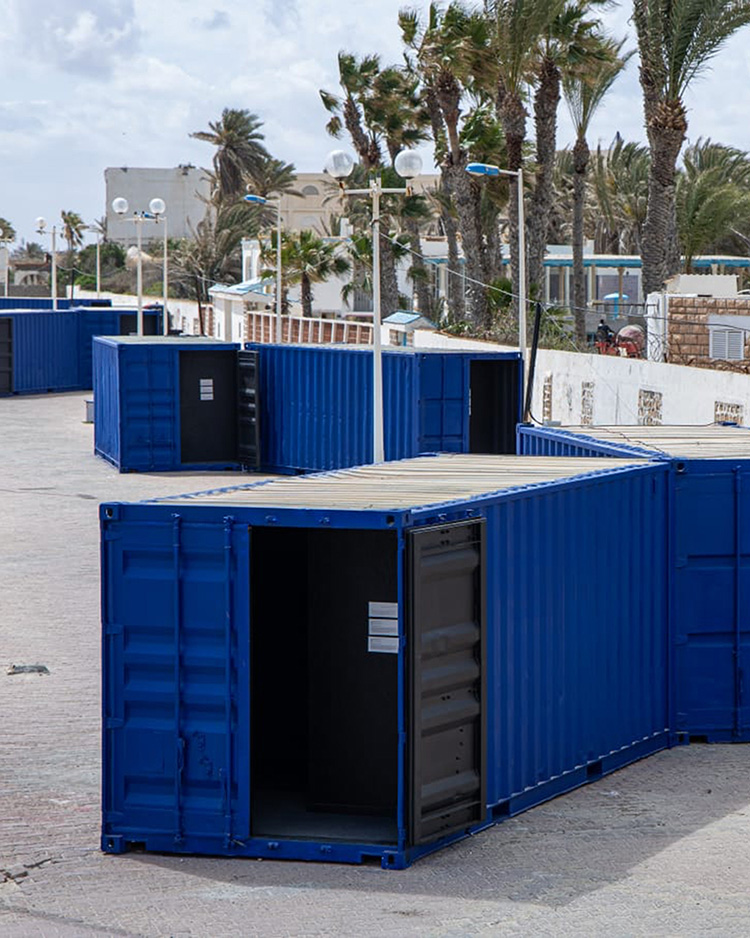
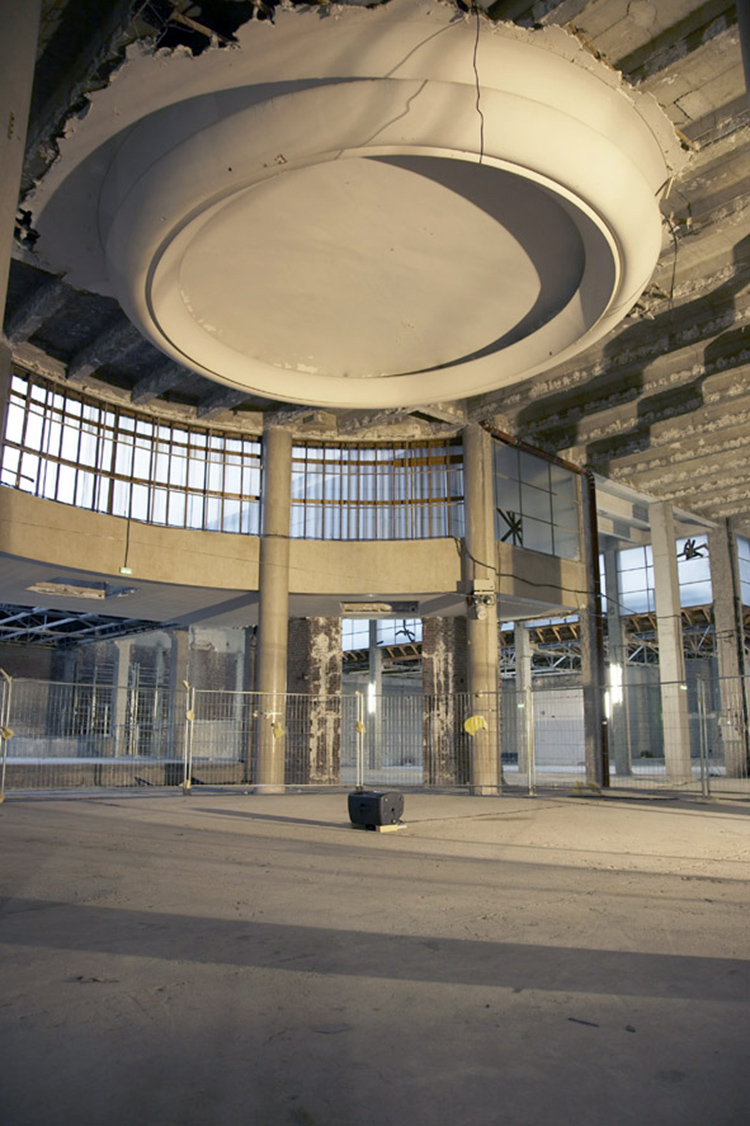
Invited to occupy the construction site of the Palais de Tokyo 2, my intervention consisted of using a mechanism to set the barriers enclosing the vast space into vibration. As a result, the movements and sounds, extremely present at the entrance, gradually faded away as visitors advanced toward the interior of the building.
Invité à investir le chantier du Palais de Tokyo 2, mon intervention consistait, au moyen d’un mécanisme, à mettre en vibration les barrières clôturant le vaste es- pace. De telle sorte que les mouvements et les bruits, extrêmement présents à l’entrée, s’évanouissaient progressivement en même temps que les visiteurs avançaient vers l’intérieur du bâtiment.
Musique moins mélodie.2
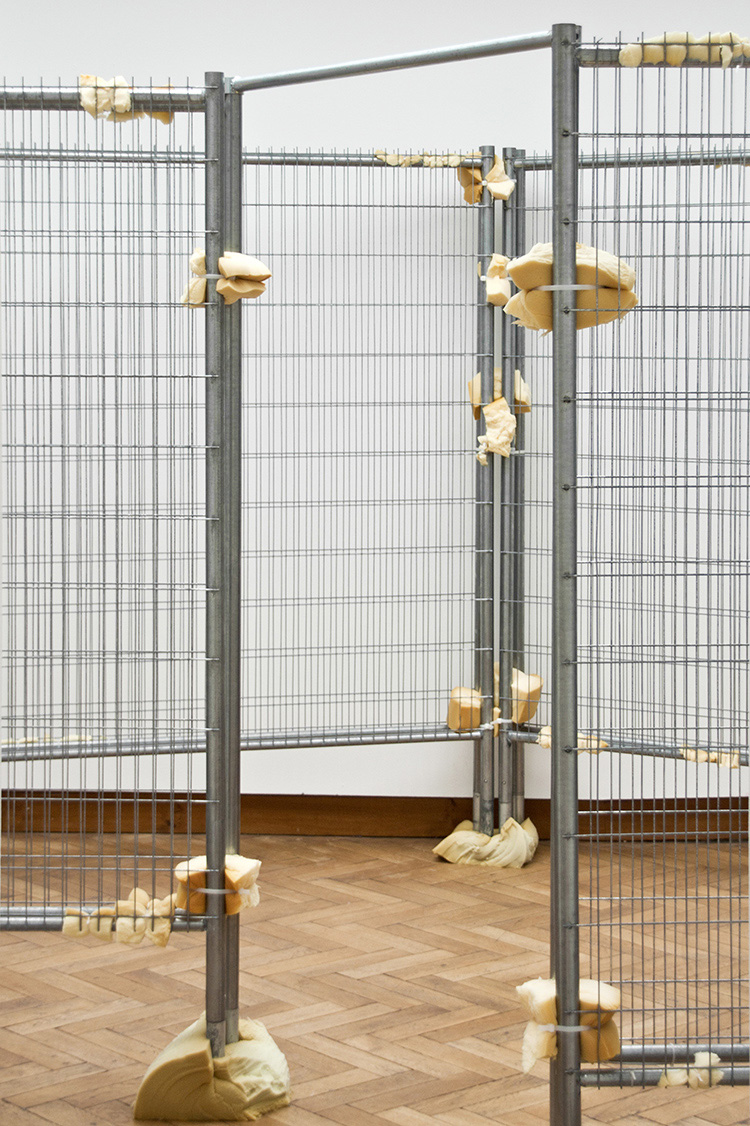
Construction barriers are added according to two constraints: maintaining the widths of the existing entrances and keeping as close as possible to the walls of the exhibition room. The length of the barriers (347 cm), taken as the construction unit, introduces a margin of imprecision that prevents the shape of the structure from being identical to the floor plan of the room.
Vibrations are transmitted to all the barriers; the resulting collisions and noises are dampened and ultimately muffled by inserting pieces of synthetic foam. These elements become the indication that a sonic phenomenon is contained.
The spatial staging of the installation occurs in two stages and in two modes: first, the transmission of vibrations to the barriers; second, through successive adjustments, by attenuating the audible effects of the vibrations (isolating the barriers from one another and isolating them from the floor).
The vibrations traveling through the entire structure blur certain areas — a phenomenon that spreads, regulates itself, and reaches equilibrium by following, through the mesh, the paths of least resistance.
Des barrières de chantier sont adjointes suivant deux contraintes: conserver les largeurs des entrées exis- tantes et longer, au plus près, les murs de la salle d’exposition. La longueur des barrières (347cm) prise comme unité de construction, introduit une marge d’imprécision empêchant que la forme de la structure soit identique au plan de la salle.
Des vibrations sont transmises à l’ensemble des barrières ; les entre-chocs et les bruits qui en résultent sont amortis et finalement étouffés par intercalage d’éléments en mousse synthétique. Ces éléments deviennent l’indice qu’un phénomène sonore est contenu.
La mise en espace de l’installation se fait en deux temps et sur deux modes, d’abord celui de la communication des vibrations aux barrières, ensuite, par réglage successifs, par l’atténuation des effets audibles des vibrations (isolation des barrières entres elles et isolation à partir du sol).
Les vibrations parcourant l’ensemble de la structure, rendent floues certaines zones; un phénomène qui se propage, se régule et s’équilibre en empruntant, à travers le grillage, des trajectoires de moindre résistance.
Contact : fabricepichat@gmail.com